



How to Get Internet Abroad: Best Ways to Stay Connected While Traveling


- Best Ways to Get Internet While Traveling Internationally
- Comparison of Travel Internet Options
- How to Get Wireless Internet Anywhere in the World
- Mobile Internet for Travelers: What to Know Before You Go
- Can You Get Cheap or Free Internet Abroad?
- eSIM for Travel: the Easiest Way to Get Internet Abroad
- Final Tips: How to Stay Connected Anywhere in the World
- FAQ
In 2026, the baseline expectations for travel connectivity have fundamentally shifted. Travelers are no longer just looking to load a static map or send a quick text; modern itineraries demand bandwidth capable of supporting high-definition video calls, cloud-based gaming, and heavy remote-work applications on the go. Securing high-speed mobile internet for travelers has evolved from a luxury into an absolute necessity.
Fortunately, the days of being restricted to exorbitantly priced carrier plans or relying on unsecured networks are over. The global connectivity landscape has transformed dramatically, offering travelers highly efficient, digital-first solutions tailored to any destination.
This guide will break down exactly how to get internet anywhere in the world, compare the advantages of modern travel internet options, and help you determine the smartest setup for your next journey.
Looking for instant internet when you land?
Skip airport SIM queues and roaming fees. Get online in minutes with a global eSIM you can activate before your trip.
Search your destination and choose a plan before you travel.
View eSIM plansDownload the app and activate your eSIM in minutes.


Best Ways to Get Internet While Traveling Internationally

When evaluating the best way to get mobile internet overseas, modern travelers generally have five primary avenues to choose from. Here is a look at the mechanics, benefits, and current realities of each method.
SIM
Historically, the standard procedure for securing cheap international internet was to purchase a local physical SIM upon arrival. However, as of early 2026, many major phone manufacturers globally have transitioned mid-tier and flagship models to entirely eSIM-only designs. Consequently, the era of searching for an airport telecom booth is rapidly becoming obsolete.
Furthermore, international telecom laws have grown much stricter. For instance, on January 9, 2026, Mexico enacted mandatory biometric and ID registration for all local SIM purchases, meaning tourists must present their passports and take a biometric "selfie" just to gain access.
Roaming
Relying on your domestic telecom provider to route data through foreign towers is known as roaming. While keeping your existing phone number active requires zero setup, the financial toll is often severe. In non-regulated regions, standard pay-as-you-go rates can still reach a shocking $7.00 to $10.00 per megabyte. Even if you purchase a daily travel pass for roughly $10 a day, a standard week-long vacation will easily cost you $70.
Additionally, this "second-tier" data routing often suffers from high latency. Your connection may cause frustrating lag during Zoom calls or FaceTime sessions because the signal must travel all the way back to your home country's servers before reaching its final destination.
eSIM
If you are searching for the best way to get internet when traveling, the international eSIM is widely recognized as the ultimate modern solution. Rather than a physical chip, an eSIM is an embedded virtual profile that activates over-the-air.
With more than 1.5 billion eSIM connections active in 2026, securing internet access has transformed from a tedious physical task into a three-second digital activation. It is also incredibly cost-effective; a standard 7-day travel eSIM averages between $4.50 and $15.00, yielding a massive 75% to 90% cost reduction compared to traditional roaming day passes.
WiFi
Utilizing public wireless networks in cafes, hotels, or transit hubs remains an option for those on a strict zero-dollar budget. While it costs nothing, it carries substantial drawbacks regarding security and consistency.
Public networks are notoriously unencrypted, making it dangerous to check banking apps or enter passwords without routing your activity through a dedicated Virtual Private Network (VPN). Moreover, in regions like Southeast Asia, the 5G cellular data provided by an eSIM routinely outperforms the complimentary networks offered by boutique hotels.
Want the simplest way to stay connected abroad?
Set up your eSIM in a few taps and access fast, local data in 190+ countries—no physical SIM required.
Browse data plans for 100+ countries and pick what fits your trip.
Browse plansInstall the Yolla app to view plans and manage everything in one place.
Other Options
Travelers with specific hardware demands or unusual itineraries might consider these alternative setups:
- Pocket Wi-Fi / Mobile Hotspots: These are standalone, battery-powered routers that broadcast a localized internet signal using cellular data. They are excellent for groups sharing a connection but require you to carry and charge an additional piece of hardware.
- USB Dongles: These compact plug-in tools provide a direct mobile internet link to a single laptop, making them highly beneficial for remote workers who demand stability.
- Direct-to-Device Satellite: For explorers navigating complete dead zones, 2026 is a milestone year. Following the February 2026 launch of satellite-to-mobile data services by carriers like Virgin Media O2 and Starlink, integrated satellite messaging ensures off-grid travelers are rarely ever out of reach.
Comparison of Travel Internet Options

To easily visualize the best way to access the internet when travelling, we have compiled a connectivity matrix. This highlights how the top methodologies compare across the most crucial metrics.
|
Connectivity Method |
Average Financial Impact |
Setup & Activation Effort |
Performance & Reliability |
Ideal Traveler Profile |
|
eSIM |
Highly Economical ($4.50 - $15/week) |
Minimal (Instant digital QR/App activation) |
Exceptional (Direct 5G access) |
Digital nomads, multi-destination explorers, and frequent flyers. |
|
Home Carrier Roaming |
Extremely Expensive (~$10/day or pay-per-MB) |
Zero (Automatically engages upon arrival) |
Moderate (Prone to high latency) |
Travelers taking very brief trips where corporate budgets cover expenses. |
|
Local Physical SIM |
Economical |
High (Requires physical stores and biometric ID checks) |
Exceptional |
Expatriates or travelers relocating to a single nation for months. |
|
Public Wi-Fi Networks |
Free |
Moderate (Requires captive portals and VPN logins) |
Poor (Unsecured and prone to dropping) |
Budget backpackers utilizing it strictly as an emergency backup. |
|
Portable Pocket Wi-Fi |
High (Rental fees + steep hardware deposits) |
High (Requires carrying and charging a separate router) |
Exceptional (Supports multi-device tethering) |
Large families managing tablets, laptops, and multiple smartphones. |
Key differences (price, convenience, speed)
Selecting your ideal international wireless internet plan requires a careful balancing act. Traditional roaming wins the convenience category but is an utter failure regarding price and latency. Conversely, open wireless networks win on price but fail spectacularly in both speed and data security.
The undisputed champion across all three categories is the eSIM. It delivers the premium localized speeds and budget-friendly pricing of a physical chip while completely matching the instant, frictionless convenience of traditional roaming plans.
How to Get Wireless Internet Anywhere in the World
Guaranteeing international wireless internet regardless of your global coordinates requires pairing the right software with your itinerary. For 99% of urban, suburban, and coastal travel, a global eSIM is the ultimate tool. Instead of purchasing a localized plan every time you cross a border, a global eSIM autonomously negotiates connections with regional cell towers, ensuring uninterrupted data as you move from country to country.
For the 1% of travelers venturing completely off the grid — such as deep-sea sailors or mountaineers — the strategy shifts toward satellite technology. While bulky hardware was previously required, the 2026 advent of direct-to-device satellite data ensures that even if you leave cellular range entirely, basic messaging and emergency connectivity remain intact in your pocket.
Stay connected wherever your trip takes you
Plan your data setup in advance so you’re not relying on unstable or expensive connections when you arrive.
Find your destination and choose the right eSIM plan before you travel.
Browse eSIM plansDownload the Yolla app to explore eSIM plans in one place.
Mobile Internet for Travelers: What to Know Before You Go

Securing mobile internet internationally requires a bit of pre-flight preparation. Implementing these technical adjustments will save you from frustration and financial penalties:
- Verify your hardware limitations: Never assume you can rely on a plastic SIM card at your destination. By 2026, the majority of flagship smartphone models ship without physical SIM trays. Confirming your device's internal eSIM capabilities is a mandatory pre-trip step.
- Navigate the new European FUP rules: If you plan on using a home carrier for internet access in Europe while traveling, beware of the fine print. While the EU's "Roam Like at Home" initiative exists, 2026 ushered in aggressive Fair Usage Policies (FUP). Utilizing more data abroad than you do domestically over a four-month period will trigger harsh overage penalties of approximately €1.30 per GB.
- Throttle background data: Your applications will silently consume bandwidth if left unchecked. Navigate to your device settings to disable "background app refresh" and automatic cloud syncing. Engaging "Low Data Mode" will dramatically extend the lifespan of your prepaid data packages.
- Harden your digital security: Ensure your device is instructed to "forget" open networks and disable auto-join features. Prior to departure, execute a fully encrypted cloud backup of your hard drive and verify that remote-wiping software (like "Find My") is actively tracking your device.
Can You Get Cheap or Free Internet Abroad?
Yes, achieving highly affordable — or entirely free — connectivity is possible, provided you understand the associated risks.
If your budget is non-existent, you can strictly utilize public networks found in hotel lobbies, transit centers, and coffee shops. For a comprehensive strategy on zero-cost connectivity, you can review our guide on finding complimentary public Wi-Fi in any global destination.
However, relying on open networks introduces severe vulnerabilities. Unencrypted hotspots allow bad actors to intercept your digital footprint. You should never process payments or access sensitive portals without running a Virtual Private Network (VPN) to mask your traffic. Additionally, these shared networks are notoriously congested.
For travelers seeking cheap international internet without compromising digital safety, prepaid eSIMs are the definitive choice. While legacy carriers charge up to $10.00 per megabyte for standard roaming, a dedicated travel eSIM provides a full week of high-speed bandwidth for an average of just $4.50 to $15.00. This equates to up to 90% in savings, offering secure connectivity for the price of a single airport lunch.
Want affordable internet without the risks of public Wi-Fi?
Get reliable mobile data at local rates — without exposing your data on unsecured networks.
Compare plans by country and find the most cost-effective option for your trip.
Browse eSIM plansDownload the Yolla app to explore low-cost data plans and stay secure abroad.
eSIM for Travel: the Easiest Way to Get Internet Abroad

For travelers demanding a harmonious blend of reliability and affordability, the international eSIM has dominated the 2026 travel market. Operating as an embedded virtual chip, it grants you over-the-air access to premium foreign networks without ever requiring a physical hardware swap.
While the general digital setup process is fast, frequent travelers can unlock significantly more value by utilizing a specialized ecosystem like the Yolla eSIM. While standard digital providers lock you into restrictive terms, Yolla was engineered with unique traveler-first advantages:
- A singular global footprint: The most defining feature of our service is the provision of one universal eSIM for all supported countries. You do not need to download and configure a new profile every time you book a flight. You install the framework once, and simply purchase localized data packages whenever required.
- Zero-expiration data packages: The industry standard is to force users into rigid 7-day or 14-day validity windows, causing unused data to vanish. Our data packages never expire after purchase. You can lock in highly competitive rates today and activate the bandwidth during a vacation a full year later.
- Unified app management: The Yolla eSIM is natively integrated directly into the Yolla calls app. Existing users bypass redundant registration screens entirely, allowing them to oversee both their high-definition voice calling and global mobile data within a single, streamlined interface.
Because the service operates on a 100% prepaid model, the threat of post-vacation bill shock is entirely eradicated. Furthermore, the technology autonomously bounces between premium regional networks, ensuring your device always latches onto the most powerful 4G or 5G signal available in your immediate vicinity.
Ready to get online before your trip even starts?
Install once, use worldwide. No expiration on data, no bill shock—just reliable internet wherever you go.
Find your destination and get your eSIM ready in advance on the Yolla eSIM website.
Find Your eSIM PlanDownload the Yolla app and manage your eSIM plans directly in one place.
Final Tips: How to Stay Connected Anywhere in the World
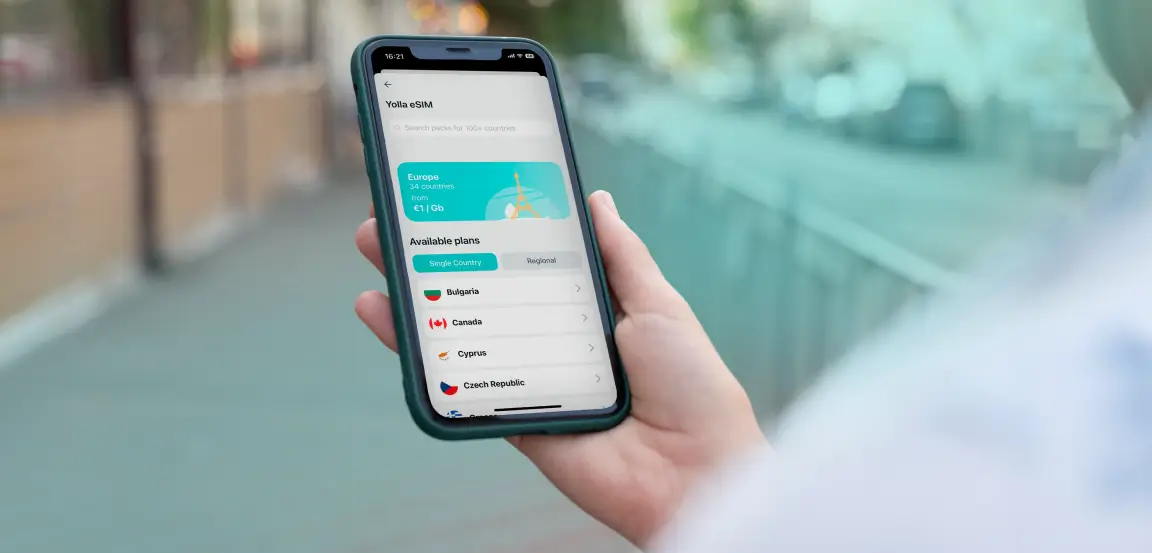
Once your Yolla eSIM is configured and your bandwidth is secured, you have eliminated the heaviest logistical burden of your trip. To extract the maximum value from your mobile internet overseas, deploy these advanced connectivity tactics:
- Pre-load offline infrastructure: Even with flawless international internet plans, venturing into dense national parks or rural valleys can result in signal drops. Always secure offline geographical maps and capture digital screenshots of your boarding passes and reservation codes before leaving a reliable connection.
- Embrace "Silent Roaming": A prominent strategy among savvy 2026 travelers is the "Silent Roaming" configuration. This entails leaving your domestic SIM active purely to intercept crucial SMS messages (such as banking authorization codes) while forcing your secondary eSIM to handle 100% of the data burden, expertly dodging daily carrier roaming fees.
- Migrate your voice traffic: Because modern travel eSIMs prioritize data, traditional cellular minutes should be bypassed. Instead, you can utilize your robust data pipeline for making internet-based calls overseas.
- Eliminate communication borders: By understanding the benefits of internet calling apps like Yolla, you can bypass the predatory per-minute rates of legacy carriers and seamlessly dial landlines, businesses, or family members back home with pristine audio clarity.
Ultimately, securing a connection in a foreign territory no longer needs to be a source of anxiety. You do not have to be the passenger desperately hunting for a captive Wi-Fi portal at the baggage carousel or dreading the inevitable roaming invoice. By deploying a universal eSIM and hardening your device's data settings before departure, you ensure that the moment the plane touches the tarmac, you are instantly online and ready to navigate.
Get everything set up before you travel
Avoid last-minute stress — plan your data in advance so you’re connected the moment you arrive.
Search your destination and compare available eSIM plans.
See eSIM plansDownload Yolla and access eSIM plans at any time — right from the app.
FAQ
How do I get internet while travelling and abroad, plus what are the best options in…?
- Europe: While EU citizens still utilize "Roam Like at Home," 2026 saw the implementation of aggressive Fair Usage Policies. Exceeding your domestic data habits abroad now triggers fees of roughly €1.30 per GB. A regional European eSIM is the most effective workaround to dodge these stringent limits.
- USA: America boasts a formidable 5G network, but attempting to purchase a prepaid physical chip at a US airport kiosk is notoriously overpriced for international visitors. Securing a digital eSIM prior to landing is drastically cheaper.
- Latin America: Topography heavily influences signal strength across Latin America. Utilizing a multi-network regional eSIM is crucial here, as the technology autonomously scans and connects to whichever local tower is broadcasting the strongest signal in your specific province.
- Southeast Asia: The digital nomad hubs of Thailand, Vietnam, and Singapore now boast widespread 5G access for digital SIMs. This cellular throughput consistently demolishes the speeds offered by the complimentary networks in budget hostels.
- Mexico: Following the January 2026 legal mandates, acquiring a local physical SIM in Mexico requires tourists to submit passport documentation and biometric scans. A digital travel plan entirely bypasses this invasive bureaucracy.
- Middle East: Overcoming language barriers at physical retail locations can complicate telecom purchases. Pre-loading a regional eSIM ensures you circumvent the retail experience and have instant mapping capabilities upon arrival.
What is the best way to get internet when traveling?
The absolute best method is deploying an international eSIM. It guarantees premium data speeds, completely eliminates the need to fiddle with physical hardware, and relies on a prepaid structure that fundamentally protects you from post-trip roaming extortion.
How to get wireless internet while traveling internationally?
You have five primary methods: installing a digital eSIM, purchasing a localized physical chip, enabling your domestic carrier's roaming package, renting a battery-powered Pocket Wi-Fi router, or relying on open public hotspots. For the vast majority of trips, eSIM data provides the highest security-to-cost ratio.
What are the cheapest travel internet options abroad?
Zero-cost public hotspots are the cheapest, but they sacrifice safety and reliability. For dedicated, secure connections, travel eSIMs represent the pinnacle of value in 2026, averaging between $4.50 and $15.00 for a week of connectivity — a staggering 90% discount compared to traditional $10/day roaming passes.
How does mobile internet work overseas?
Your device establishes an internet connection by communicating with foreign cell towers. This is achieved either through expensive "roaming" (where your home provider rents space on a foreign tower) or by downloading a regional eSIM, which effectively turns your phone into a localized device with native access to those towers.
Can I use my phone internationally without roaming charges?
Absolutely. By deactivating "Data Roaming" on your primary domestic line and routing all your bandwidth through a 100% prepaid travel eSIM, you completely insulate yourself from your home provider's surprise international fees.
Is eSIM better than a physical SIM card for travel?
Yes, in almost every scenario. It removes the necessity of queuing at airport kiosks and submitting your passport for foreign telecom databases. Moreover, as global manufacturers increasingly release smartphones lacking a physical SIM tray altogether, the digital profile is rapidly becoming the sole connectivity avenue.
How do international internet plans work?
Legacy plans provided by your domestic carrier typically charge a flat daily toll (e.g., $10 per 24 hours) simply to access your existing domestic data limits abroad. Conversely, modern prepaid travel plans via digital SIM allow you to purchase distinct data buckets (e.g., 5GB valid across multiple borders), granting you total financial control.
Can I rely on free WiFi when traveling?
You should treat complimentary networks strictly as an emergency fallback, not a primary strategy. Open networks in cafes and transit hubs lack encryption, exposing your device to cyber threats. Furthermore, they suffer from severe congestion and offer absolutely no help when you require GPS routing while in transit between locations.